The Rise of “Multi-Screen” Everything


In today’s digital world, working or gaming on a single screen has become almost IMPOSSIBLE. With more complex tasks, applications, and entertainment happening simultaneously, people are turning to multiple monitors to stay organized, connected, and productive. But what does it really mean to live in a “second-screen” world, and how does it actually change the way we work, play, and relax?
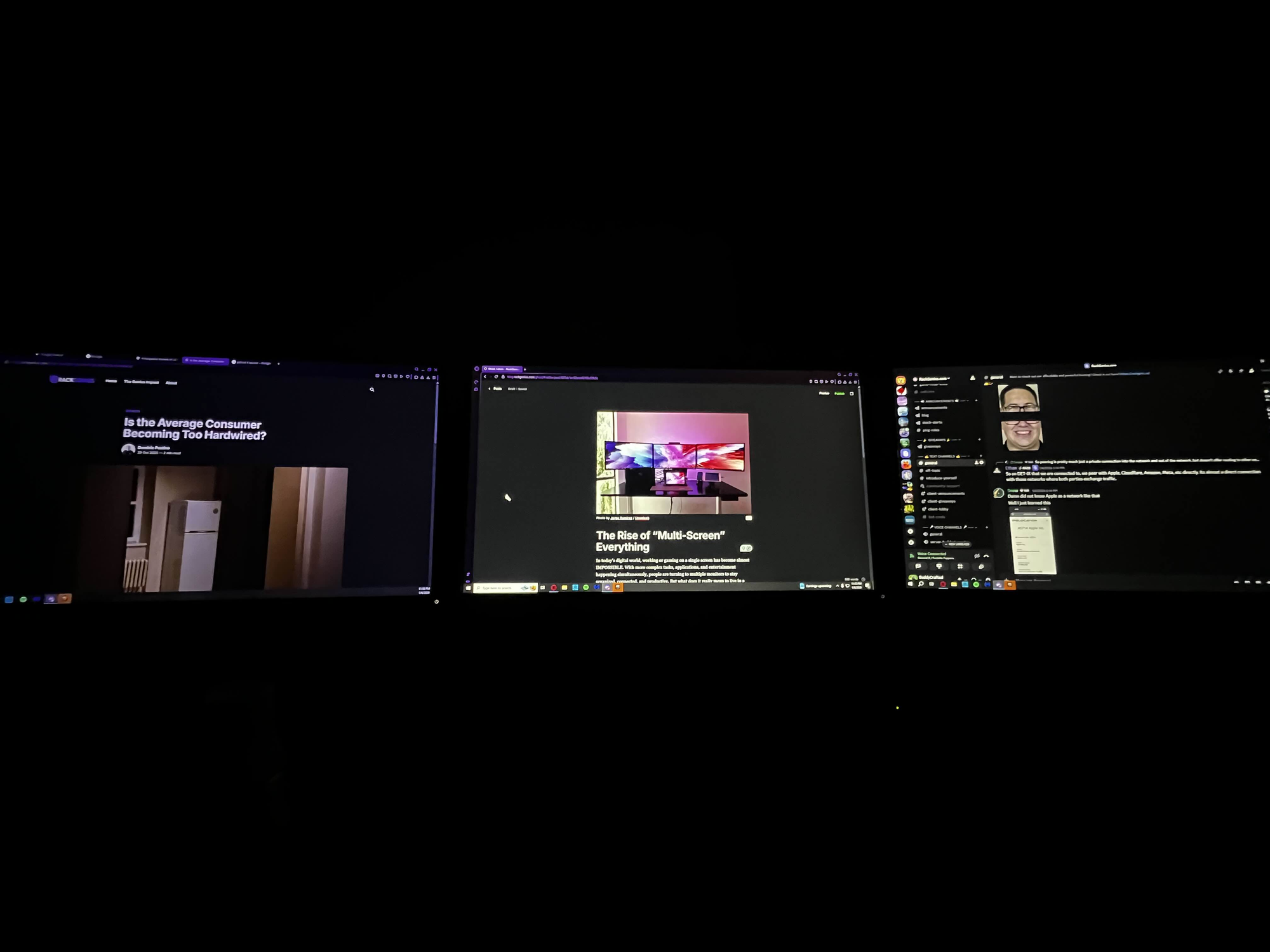
For me, it comes down to three screens. One is dedicated to whatever I’m working on or playing at the moment. The second is for Discord, so I can stay in touch with friends, jump into conversations, and see messages without interrupting what I’m doing. The third screen usually has something in the background, like Family Guy funny moments or a Twitter (X) highlights that keeps things interesting while I focus on tasks or gaming. Having each screen serve its own purpose makes everything feel less chaotic and keeps me from constantly minimizing and switching windows.
What’s funny is how this kind of behavior slowly became normal without anyone really noticing. Think about how most of us use our devices outside of a desk setup. You’ll be watching a show while scrolling on your phone, replying to a text during commercials, or pulling something up on your phone while a video is playing on TV. It’s second-screen behavior everywhere, even if we don’t call it that, and once you start paying attention, you realize how often you’re already doing it.
This really shows up when I’m working across different projects during the day. I might have RackGenius work pulled up on one screen, writing content, managing socials, or checking on campaigns, while another screen has BirdPals artwork, notes, or ideas open so I can jump between creative work without losing momentum. Sometimes Eastern Studios projects are mixed in too, especially when I’m bouncing between client work and personal projects. On top of that, I usually have music playing, a video running, or Discord open so the space feels alive instead of silent. Having everything visible lets me move between tasks naturally instead of constantly reopening tabs and trying to remember where I left off.
A big reason this setup works is that nothing really lives in just one place anymore. Games aren’t just the game itself. There are voice chats, guides pulled up in a browser, streams running in the background, updates downloading, and friends messaging you at the same time. Even when you’re just relaxing, you might have Bluetooth surround sound connected, Spotify playing, and something scrolling on your phone. All of that is happening digitally at once, so trying to squeeze it all onto a single screen starts to feel cramped and frustrating instead of productive.
That’s where the multi-screen setup really starts to shine, not just for me but for many. I’m not constantly breaking my workflow to hunt for the right window or minimizing everything just to respond to a message. Everything has its place and stays visible. One screen stays locked into the task I’m focused on, one keeps communication and side projects easy to access, and the third keeps something fun or relaxing in the background so it doesn’t feel like I’m sitting in silence grinding away. It creates a rhythm that makes long sessions easier to enjoy, and at this point, second-screen setups don’t feel like a trend anymore. This just shows how life online works now.